

Fight your autopilot to build sustainable fitness
Have you ever noticed how much time we spend trying to reach new heights, only to fall back to where we started on bad days? What if, instead, we focused on raising our lowest points? By improving our worst days, we build a strong foundation for lasting growth and resilience. That’s my theory behind what we’re doing anyway.
Mountain bike mayhem
I’ve just woken up, it seems. Last week, was a little bigger than my recent ones with hiking, family time, mountain biking, more hiking, and then finally 2 hours and 20 minutes of flailing around in the pouring rain on the mountain bike once more. It was a tough afternoon with deep, sticky sandy mud dragging on every single peddle stroke and knee-deep water covering the entire track. Throw in a few steep hills and the recipe spits out one tired me on Monday morning.


It wasn’t until something, on Wednesday, made me realise I’d been on autopilot for a few days. In survival mode. My step count is at its lowest ebb. No other activity. Just the basics (and to be fair, looking after kids, is never quite so simple). As an illustration, my step count which has been in the 10–12k mark on average plummeted to below 5k.
Once I’d realised I was on autopilot, it was a little bit of a battle to fight my way out and wrestle back the controls, but I did. Some walking and a little bit of mobility and it feels like I’m back.
Reflecting, this is a fairly consistent occurrence.
Whenever I’ve trained in the past, whether it was for cycling sportives, triathlons, trail races, or the ill-fated marathon attempt — it’s the last time I’ll mention that for a while, sorry — I’ve always had a plan to follow. These plans varied but usually lasted between 12–24 weeks, depending on the event.
My primary focus was always on the workouts: the intervals, the sprints, the ones that emptied the tanks. Given the challenges with recovery I have, these intense workouts often led to missed sessions, usually the easier ones. “They’re easy, right?” I’d think.
On those days, movement was at a bare minimum. The priority was a chair or sofa. The same thing has happened this week. Movement became a low priority. This is where my current floor is. those days when I’m tired, and stressed, and I go into autopilot. This shows me that my habits and systems aren’t up to the level they need to be to help consistently hit my targets.
This means there’s work to be done in developing and building a system, an active life that creates more movement and meaning. Something that you don’t get by sitting at a computer all day or staring into the abyss of social media on your phone (I’m talking to myself here).
“You do not rise to the level of your goals. You fall to the level of your systems.”
James Clear
And my systems are clearly not working.
So what we (I) need to do is raise the floor. What happens on your worst days? What work are you doing? How much can you influence your autopilot so that when you do head there, it doesn’t end up doing nothing at all?
Raising the Floor
At its most basic, Raising the floor means improving your lowest performance days rather than just focusing on reaching new heights on your best days. This approach ensures that even when things don’t go perfectly, you’re still making progress. In the long term, by improving your worst days, your autopilot is going to have a much more profound impact on your life. Especially since the activity associated with the raised floor can help get you out of that autopilot. The core concept of moving more actually has the benefits of movement, nature, and time all blocked into one. So regardless of the stressors that have led to you losing control, be they exercise, work, or personal. The act of moving itself helps to at least start to clear a little of the mental fog.
“Mood follows action”
Rich Roll
This is just one of the benefits this approach brings. The peak performance approach, whilst it can be successful, isn’t for everyone, and, arguably, whilst it gets results in the short term, it doesn’t necessarily lead to long-term improvements. Think of the number of people in the world who’ve followed a plan, be it for a 5km, a marathon, a Triathlon, or more, and then, once they’ve finished their events they move on. They stop exercising, the autopilot kicks in and they return to their mean, slowly or quickly. It’s certainly something I can relate to.
It feels like it’s not just related to us in the season of our lives but also back to school, where you’d do summer and winter sports. In my case, from the start of the school year, I was training for and playing rugby. As soon as the rugby season ended, the focus switched entirely to athletics. Once the summer athletics season was over, it was back to rugby. You finish a season and move on. This seems to, in my mind, play out now. A season of triathlon, then winter. A season of running, then winter. Before a season of football, then summer.
You trained and played hard. Then you stopped. Only to start again once the season came back around.
The idea of raising the floor, as part of the process to become a more well-rounded athlete aims to smooth out the highs and lows and reach a state of steady progress. You do this by making sure you have a baseline that allows for, very incremental improvement. Now, depending on your level of fitness, what that looks like will be different. For me, right now, it’s fairly simple, using Elevate (an app that gives you a deeper overview of your activities, sort of like a free Training Peaks), I can see that it takes roughly a 40-minute easy walk or a 30-minute brisk walk to avoid losing fitness. An hour’s worth of walking will see me improve, ever so slightly.
Compound that over not just weeks or months and it all adds up.
At it’s most basic:
- Peak Performance: Focuses on achieving the best possible outcome, often leading to burnout and inconsistency when results aren’t met.
- Raising the Floor: Emphasizes steady, sustainable improvement by ensuring that even your worst days are productive.
Fitness Foundations
The basics of the foundation to the entire concept of becoming a tactical athlete and being truly adventure-fit comprises three key building blocks. These are what help to maintain sustainable progress and these are the things that I need to work more on ensuring they fit into the schedule every single week without fail.
The current foundations that I’m building on:
- Daily Walking: Ensures you’re getting consistent, low-impact exercise. An hour a day is the rough goal right now, it can be replaced with cycling or other easy activities too
- Steps: In addition to walking, hitting a baseline of steps a day keeps movement up through the day and avoids being too sedentary. This is a big area for me as I work from a computer at home, so the temptation to stay put and not move is very strong. Especially since there’s nowhere to walk to as an excuse for moving.
- Mobility Exercises: Keeps your body flexible and reduces the risk of injury. This is a core focus of mine and one that I still, despite knowing its importance, let go of all too often.
- Basic Strength Training: Building foundational strength to allow you to be adaptable and in essence strong enough to train but also hit those adventures when they arrive.
For me, they all have their place and, the impact they have, really does go beyond that of simply getting fitter and stronger in the long term. I’ve found that my walks, as a surprise to absolutely no one, have been wonderful for my mind. Whether it’s spending time with friends in the great outdoors or, as is more often the case getting time to spend alone. To reflect. To think through problems or challenges has been a great benefit. Just grabbing my phone out of my pocket and dictating ideas as they come to mind has been powerful (whilst carefully and intentionally trying to avoid looking at the temptation that is the screen.
The mobility work has also had a smaller, albeit similar impact. There’s the awareness in your body it builds that is almost meditative. The feeling of knowing exactly how a movement affects the varying different muscle groups, the way that the same movement on one side can feel different to the other. Once you’ve managed to fight past the ‘oh this is terrible’ thoughts, suddenly the awareness it brings into your body just makes you understand things a little differently.
These are the things that I want to do more of, and I want to ensure the systems and processes that run my life help me to move toward them.
Systems and processes
And herein lies the key and the bit that is currently missing from my life and fitness journey.
There’s an awful lot of advice out there, that advises things like walking the stairs instead of taking the lift. Or park your car at the furthest point in the car park from the office or shop. These things help a little in addition to things like parking in town to walk and collect the kids from school, rather than parking at the school. Another favourite is being inefficient on purpose. For example when you’ve been shopping, normally I’d attempt to bring all the bags in at one time, now I try to be less efficient and bring one in at a time.
These things, are, whilst great, only small and don’t move the needle on the overall movement score for a day or a week.
Other ideas are very much a forcing function for day-to-day living. You can set things up like:
- Morning Routines: Start your day with a set routine that includes movement, stretching, and a healthy breakfast.
- Time Management: Schedule regular breaks for physical activity during work hours.
- Reflection and Adjustment: Regularly review your progress and adjust your plans as needed.
But these can very quickly come undone once the autopilot kicks in. This is the true battle and one that I’m missing the answer for. The forcing function of things like scheduling movement becomes a point of resistance, and let’s face it when you’re autopiloting working on a computer, an alarm goes off telling you to move, it gets ignored.
The best way I’ve come across so far, and this isn’t perfect, is about building awareness. The whole thing about the autopilot is that you don’t think about it, you’re just doing the things you need to do, and almost everything else can slip away.
What’s the core process for building awareness? For me, it’s my activity journal. Which takes the form of a spreadsheet in Google Sheets that I fill out almost every day.
If I’m not hitting the basic foundations above, it shows red for each area. A couple of days of red in a row is like an override button for that autopilot and as an example on Wednesday morning, snapped me out of it.
What gets measured…
Tracking progress, even in small increments, is crucial. There’s plenty of evidence out there that shows it. Visualising information is a powerful tool that forms a foundation of communication in everything from exercise to large-scale industrial manufacturing, where we saw it while I was studying for a Six Sigma Green Belt. It helps you stay motivated and see the impact of your efforts as time passes. Now there’s a whole bunch of different options here and a lot of these will be down to what you prefer. I’ve tried to go through a few different types and am currently settled on a crude spreadsheet as I mentioned above and I shared that in my monthly overview post (here).
Tools and Methods:
- Journaling: Write down your daily activities and reflections.
- Fitness Apps: Use apps to track your steps, workouts, and overall activity.
- Spreadsheets: Create a simple spreadsheet to monitor your progress and identify patterns.
I use a combination of all of the above at different points. I’ve got a Garmin watch that tracks all my data and is my source of the cold hard facts of whether I’ve moved or not. I also use the app I mentioned before Elevate (link to the Chrome Extension) which I use to track the overall impact on fitness of any workouts (akin to Training Peaks scores fitness tracking).

I feed the essentials of that into my spreadsheet that then has some basic colour coding to show if I did something or didn’t. This is the really powerful bit.
Did you do your steps? YES or NO.
Did you do your mobility? YES or NO.
Did you workout? YES or NO.
That then tells me whether I’m on or off track and has been the thing that has helped me snap out of the funk associated with being on autopilot.
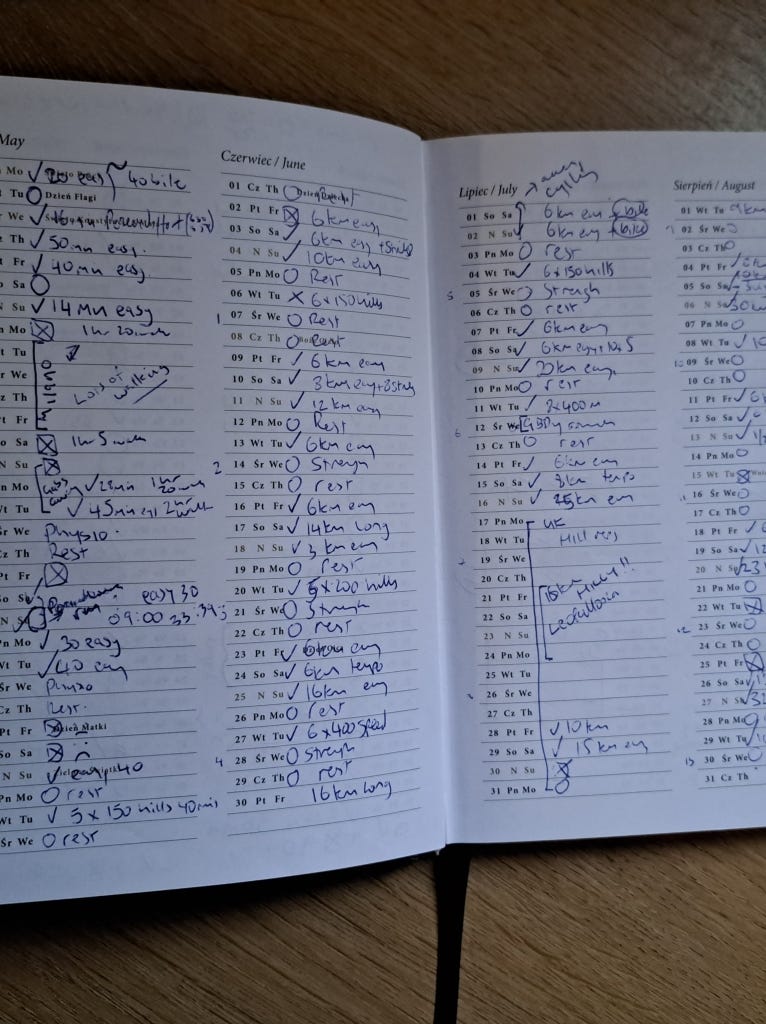
In the past and sometimes, I also use a paper planner to track workouts and similarly, whether I’ve achieved the basic goals. This has taken a little bit of a back seat recently though I’m tempted to start filling it out again as there’s something so much more tactile about writing things out vs typing them into a spreadsheet. The ease of portability is currently winning on the spreadsheet side though. Being able to see things so clearly laid out helps me know whether I’m taking steps forward or missing steps and falling backward.
Forward is forward
No matter how small the step, as long as it’s a forward one it’s moving things in the right direction. Incremental growth is more sustainable and less overwhelming. Little steps add up and compound. It’s just about making sure you are taking those steps. At this stage in my journey, it’s about fighting off my autopilot. The one that doesn’t want to do anything but rest, and unheathily stare at screens. Ignoring everything else around.
However, through awareness of when it kicks in, you can try to reduce the impact of the autopilot and help to continually raise the floor, reducing the number of autopilot low days means that you’re getting more consistency of movement. With that, you’ll consistently be able to make some form of small progress even on the tough days. Doing that will helpfully build the resilience to mean you have fewer of those bad days to start with. Then you can start to work on raising the floor step by step.
Step goals are a great place to start with this and my approach to this has been related to the 10,000 steps. I’ve gotten to a point where this is my step goal for every day. Failing to hit that gets the red tag on my spreadsheet. My plan is I want to hang out here at this level for a little while to acclimatise and normalise 10,000 steps as my basic limit. Once I’ve done that consistently with not too many red days, then I’ll progress. Next up will be a goal of 11,000 where again I’ll try to normalise. Very small progressive steps like this. In addition to trying to reduce the number of autopilot days by not going too hard too soon and trying to mitigate the stresses that cause them.
Of course, autopilot days are unavoidable, so the next step will be trying to figure out how to improve the autopilot. It is something I’ve not yet found an answer for. But if you do know, then please let me know!
Take a moment to reflect on your current habits and routines. Where can you make small changes to raise the floor of your everyday life? Start implementing these changes today, and watch how they help you build a stronger foundation for sustainable growth. Remember, every step forward, no matter how small, is progress. Let’s keep moving forward together.
Originally posted over on Medium here if you want to check it out.
 Powered by Rabbit Food